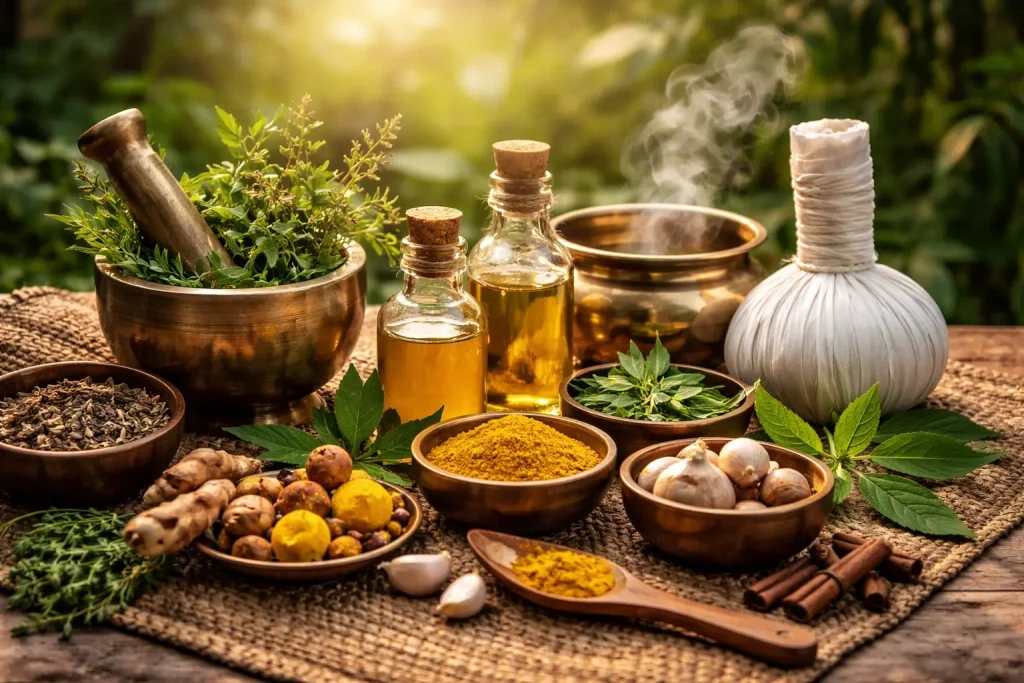
Ayurveda and Yoga are often seen as two separate wellness practices — one focused on medicine, the other on movement.
But in reality, they are sister sciences born from the same ancient Vedic wisdom.
Ayurveda prepares the body for Yoga, and Yoga deepens the healing offered by Ayurveda.
Together, they create a complete system for living a healthy, balanced, and meaningful life.
Ayurveda & Yoga: Two Paths, One Goal
Ayurveda means “the science of life”.
Yoga means “union”.
Together, their shared purpose is:
- physical wellbeing
- mental clarity
- emotional balance
- spiritual growth
Ayurveda heals the body, Yoga purifies the mind, and together they strengthen the spirit.
Ayurveda Balances Doshas, Yoga Balances Prana
Ayurveda works with doshas (Vata, Pitta, Kapha).
Yoga works with Prana (life energy).
When doshas are imbalanced:
- Vata → anxiety, overthinking
- Pitta → anger, irritability
- Kapha → lethargy, heaviness
Yoga helps regulate breath and energy flow, supporting Ayurvedic treatments.
Examples:
- Vata imbalance: Slow grounding yoga + warm oil massage
- Pitta imbalance: Cooling yoga + calming pranayama
- Kapha imbalance: Active yoga + detox therapies
Yoga Enhances Digestion — The Heart of Ayurveda
Ayurveda considers digestion (Agni) the foundation of health.
Yoga strengthens this through:
- Twisting postures → massage digestive organs
- Forward bends → improve metabolism
- Deep breathing → supports gut-brain connection
Regular practice reduces:
- bloating
- acidity
- sluggish digestion
- stress eating
Mind–Body Connection: Where Healing Begins
Ayurveda teaches that emotions affect health.
Stress can disrupt digestion, hormones, sleep, immunity, and heart function.
Yoga supports mental wellbeing by:
- reducing cortisol
- improving focus
- calming the nervous system
- regulating sleep
- promoting emotional balance
Both systems work on the mind-body link, not separately.
Panchakarma & Yoga: A Powerful Combination
After detox through Panchakarma:
- the body becomes lighter
- digestion becomes stronger
- the mind becomes clearer
- energy channels open
This makes yoga practice deeper and more effective.
During pre-Panchakarma preparation, gentle yoga supports:
- toxin mobilization
- improved circulation
- mental relaxation
Yoga Asanas That Support Each Dosha
| Vata-Pacifying Poses |
| Child’s Pose |
| Cat-Cow |
| Forward Bend |
| Legs Up the Wall |
| Pitta-Pacifying Poses |
| Moon Salutation |
| Cobra Pose |
| Seated Forward Bend |
| Cooling pranayama |
| Kapha-Pacifying Poses |
| Sun Salutation |
| Warrior Poses |
| Bridge Pose |
| Fast-paced vinyasa |
These movements complement Ayurvedic healing.
Ayurvedic Herbs That Support Yoga Practice
Ayurveda uses herbs to strengthen mental clarity and physical endurance:
- Ashwagandha → reduces stress, boosts strength
- Brahmi → improves concentration
- Shatavari → nourishes women’s health
- Tulsi → enhances breathing
- Turmeric → reduces inflammation
Combined with yoga, they create holistic improvement.
Ayurveda + Yoga in Daily Life: A Simple Routine
Here’s a basic lifestyle flow
- Wake up early (Brahma Muhurta)
- Drink warm water
- 5 minutes pranayama
- 10–20 minutes yoga
- Warm, fresh breakfast
- Mindful work breaks
- Light evening meal
- Oil massage for stress relief
- Sleep before 11 PM
This routine aligns both body & mind.
Modern Relevance: Why This Combination Works Today
Ayurveda and Yoga:
- support immunity
- reduce stress
- prevent lifestyle diseases
- improve sleep
- enhance mental health
- support hormone balance
- encourage mindful living
They counteract the effects of modern fast-paced lifestyles.
Ayurveda & Yoga at Neelganga
Institutions like Neelganga Ayurvedic Medical College & Hospital integrate Ayurvedic therapies with yogic principles to support holistic healing for patients and to train future Ayurvedic practitioners in authentic methods.
Conclusion
Ayurveda builds the foundation;
Yoga builds the stability.
One purifies the physical body;
The other elevates the mental state.
Together, they help you create a life of harmony, clarity, strength, and inner peace — not just for healing, but for living fully.